


Your shopping cart is empty!
Goji Berry (Wolfberry, Boxthorns)


Goji Berry (Wolfberry, Duke of Argyll's Tea Tree) - Lycium barbarum.
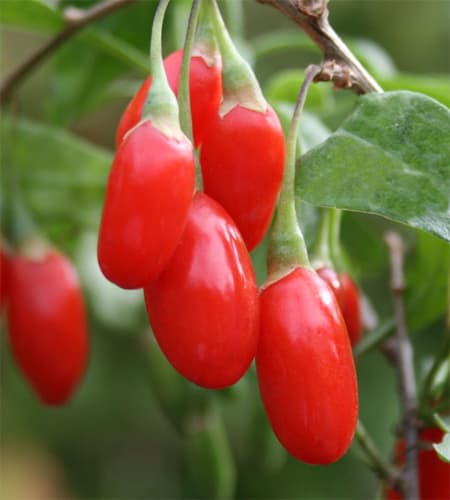
A heavily branched deciduous shrub with gracefully arching branches. Leaves are elongated, lanceolate. The fruits are the famous bright red berries. Shrub height is 1–3 m (up to 3.5 m in spread). Native to China.
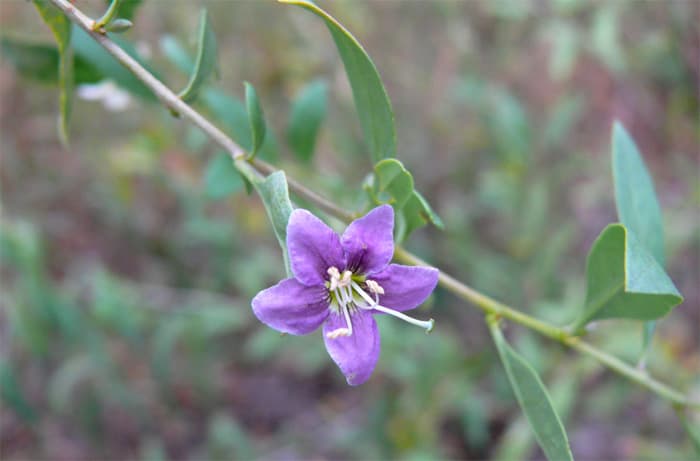
The main trunk and branches are quite thick and covered with long thorns. Leaves or flowers emerge from the base of the thorns. Pedicels are thin, often drooping. The corolla is funnel-shaped (about 8 mm), pink or lilac with dark purple veins. Berries are oval, 8–20 mm long, coral-red or orange. Blooms from June to September; fruits ripen from July to November.
Goji grows quickly and tolerates frost well, but does not tolerate dampness or waterlogging.
Soil and location.
Requires well-drained sandy soil in a sunny location.
Pruning.
In March, cut out one-third of the old shoots at the root level to rejuvenate the bush.
A heavily branched deciduous shrub with gracefully arching branches. Leaves are elongated, lanceolate. The fruits are the famous bright red berries. Shrub height is 1–3 m (up to 3.5 m in spread). Native to China.
The main trunk and branches are quite thick and covered with long thorns. Leaves or flowers emerge from the base of the thorns. Pedicels are thin, often drooping. The corolla is funnel-shaped (about 8 mm), pink or lilac with dark purple veins. Berries are oval, 8–20 mm long, coral-red or orange. Blooms from June to September; fruits ripen from July to November.
Goji grows quickly and tolerates frost well, but does not tolerate dampness or waterlogging.
Soil and location.
Requires well-drained sandy soil in a sunny location.
Pruning.
In March, cut out one-third of the old shoots at the root level to rejuvenate the bush.

Wolfberry is an unpretentious plant. It propagates easily by seeds and cuttings.
Sowing: surface sow seeds in well-moistened soil. It is necessary to maintain constant humidity during germination. Optimal temperature is about +25°C. Light is not needed for germination, but after sprouting, move the container to diffused sunlight or partial shade. First fruits may appear in the 3rd year, abundant harvest in the 4th–5th year.
Suitable for growing on ditch banks, near apiaries, and for greening wastelands. It is NOT recommended to plant Goji in cultivated garden beds! The shrub spreads aggressively via root suckers and is very difficult to eradicate later.
Medicinal Uses.
Lycium has been used for millennia. All parts are used: leaves, stems, roots, and fruits. One of the main active components is unique polysaccharides (LbGp2) with pronounced immunoactivity. They counteract free radicals, help lower blood pressure, and increase tissue sensitivity to radiation therapy (important in oncology).
Goji fruits are a rich source of vitamins A, C, and E, and essential fatty acids.
Used for hypertension, diabetes, fatty liver, vision problems, neurasthenia, and impotence.
The berries have a tonic effect and suppress the growth of E. coli and Candida fungus.
Ripe, dried, or fresh berries taste like a mix of cranberry and cherry. In Asia, eating Goji berries is linked to longevity.
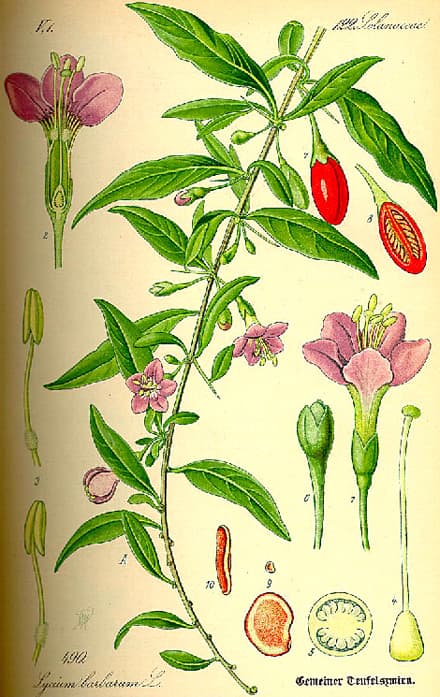
Bot. syn.: Boberella halimifolia (Mill.) E.H.L.Krause, Jasminoides flaccidum Moench, Lycium halimifolium Mill., Lycium lanceolatum Veill., Lycium turbinatum Veill., Lycium vulgare Dunal, Teremis elliptica Raf.